
Smite 2 doesn’t treat every ban the same way. A 7-day suspension, a 14-day suspension, a permanent game ban, an Easy Anti-Cheat flag, and a deserter lockout all point to very different problems.
So if you’re trying to get unbanned from Smite 2, the first important step is to check what kind of action actually hit the account. Hi-Rez’s policy uses a detailed conduct ladder, a separate deserter system, and human-reviewed ban appeals backed by logs and detection systems.
A conduct strike is not the same thing as an EAC hit
The easiest Smite 2 clue is often the length of the penalty. Hi-Rez’s conduct policy uses a 7-day suspension for the first offense, 14 days for the second, and a permanent ban for the third.
That usually points to a harassment, feeding, spam, hate-speech, or abusive-language case rather than an anti-cheat one. More severe behavior can jump past the normal ladder, so the strike count helps, but it isn’t the whole story.
That changes how the appeal should read. If the issue was toxicity, harassment, or repeated bad behavior, the cleaner approach is to stay close to the specific match, chat exchange, or report window that likely triggered it. Basically, a conduct case works better when it reads like a conduct case, not like a technical false-positive essay.
Skip the Hassle - Get Expert Help Unbanning Your Account!
Get Unbanned!EAC cases need a different kind of timeline
Smite 2 runs cheat detection through Easy Anti-Cheat. EAC also accepts ban appeals and investigates false-cheat claims, however, without disclosing the exact detection that triggered the ban.
If the restriction followed a suspected cheat flag, the appeal should stay centered on the anti-cheat context:
- when the flag likely happened,
- what software was running,
- whether there had been a patch-day issue, validation problem, or unusual background process,
- and what logs or replay references support the claim that this was a false positive.
In other words, an EAC banned Smite 2 account usually reads better when it focuses on clean process context, timing, and system evidence, not on a broad “I would never cheat” statement. EAC doesn’t disclose the exact cheat detected, so the useful work in the appeal is narrowing the timeline and backing it with whatever the player can document from the session and the machine.
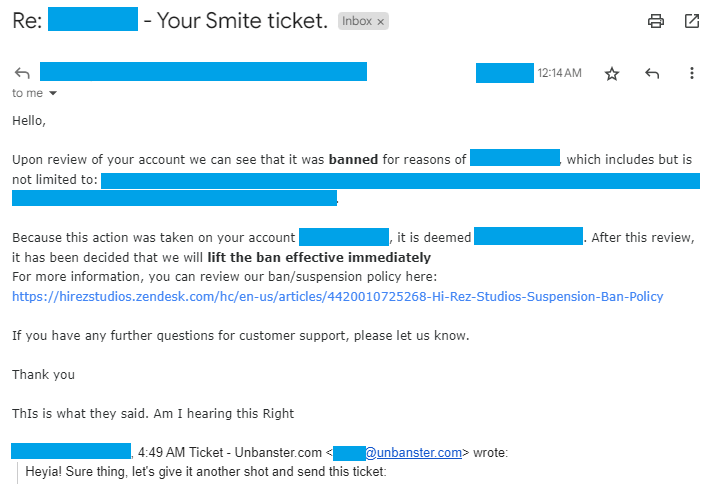
Real outcome from a Smite 2 ban appeal case handled by our team. Personal details removed for privacy.
Case type: Cheating ban appeal
What triggered it: Account was flagged by the anti-cheat system during gameplay
What we included: Context-based appeal covering what happened during the session and why the flag didn’t match actual gameplay
Outcome: Ban removed after review
Some Smite 2 bans are really about who used the account
Not every Smite 2 restriction starts inside the match itself. Some make a lot more sense once you look at who had access to the account, what changed on it, and whether the login or purchase pattern suddenly went weird.
So if the case involves account compromise, shared access, boosting, suspicious gifting, or payment trouble, say that early and keep it concrete. This is also where a lot of players bury the important part under a general denial.
For this kind of Smite 2 ban appeal, the stronger material is usually security-related: login history, password-reset emails, two-step verification changes, antivirus or system checks, and a short timeline showing when control of the account was lost and when it was recovered.
Deserter penalties have their own timer and their own logic
There’s also a separate deserter system, and it’s very mechanical. Leaving a match in progress or leaving the lobby before the match starts triggers a queue suspension. The penalties escalate through 20 minutes, 1 hour, 12 hours, and 24 hours, and the clock only resets after three days without another desertion.
That’s why a deserter-related case shouldn’t be written like a harassment case or an EAC case. If the restriction followed crashes, power loss, disconnects, or recurring connection instability, keep the explanation on that timeline. Reconnect attempts, queue timing, and a clean description of what happened usually do more work here than broad arguments about gameplay behavior.
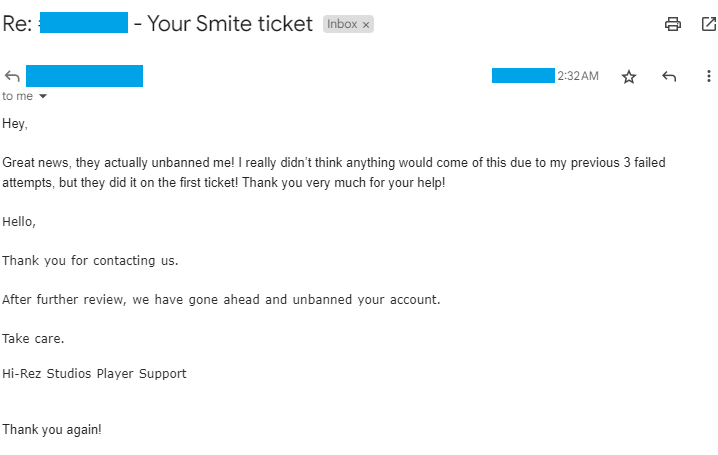
Real outcome from a Smite appeal case handled by our team.
Case type: Cheating ban appeal
What triggered it: Account was flagged during a session that raised anti-cheat concerns
What we included: Appeal walking through what actually happened in-game and why it didn’t match a cheating pattern
Outcome: Ban lifted and account restored
What should be easy to see in the appeal
By the time the ticket is read, the basic shape of the case should already be obvious. For Smite 2, that usually means making five things easy to spot:
- what action hit the account,
- what likely triggered it,
- when it happened,
- which explanation fits it,
- and which evidence supports that explanation.
In other words,
- for a conduct case, that may be chat context, the match window, and a concise acknowledgment of what happened
- for a cheating ban, that may be logs, replay or match references, and a clean system timeline
- for a compromised-account situation, that may be login history, password resets, and security proof
- for a deserter case, that may be disconnect timing and a short explanation of why the queue penalty was triggered.
Basically, the more those pieces line up, the easier it is to remove a Smite 2 ban or give the reviewer a real reason to take another look.
How to Get Unbanned from Smite 2
Here’s how to submit a ban appeal in Smite 2:
- Go to the Hi-Rez Support page and tap the blue chat bubble.
- Messages → Ask a question.
- Enter your registered e-mail, type “Smite 2 ban appeal”.
- If prompted, pick Suspension / Ban.
- Provide username & in-game name; press Enter.
- Select Game: Smite 2 (or Smite), Platform: Steam/Epic/etc.
- Detailed description: keep it under 4-500 words, provide evidence and context (when, why the ban took place), why it was a mistaken flag and how you’ll prevent it from happening again. Or, save time and stress and have us craft the perfect appeal for you!
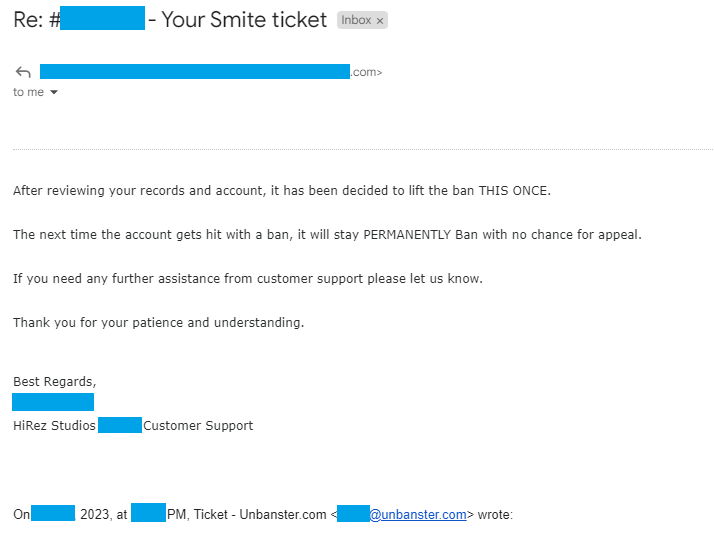
Real outcome from a Smite appeal case handled by our team.
Case type: Toxicity ban appeal
What triggered it: Account was restricted following reports related to in-game behavior
What we included: Appeal addressing the incident, providing context, and acknowledging the situation
Outcome: Restriction lifted and account reinstated
Lastly, attach any relevant files (optional, if any), and then press Enter, as you would in an actual chat. You don’t need to wait for an answer, as this will create a ticket, and they might take a few days to review it and get back to you.
We’re here to give you the best help in order to recover your account!
Get Unbanned!
Comments 6
I am not sure why I got banned, and I am banned for 6 days. The new patch came out and I loved everything. I genuinely love this game and cant wait 6 days to play it.
Honestly no idea what I was banned for on playstation
I got banned for not picking my character in time and I don’t think I’ve left a game or not picked a character in at least a week and I got a 4 hour ban for something so small
I just got banned for no reason. I was playing a game and it kicked me out of the game. I have spent a lot of money on the account and I don’t want to make another account.
Same for me I just got perma banned because it was apparently my last warning. I unfortunately didnt know anything about the previous bans bc my brother often played on my pc.
Think I got banned for lagging out or having the kind of games where you die a lot.